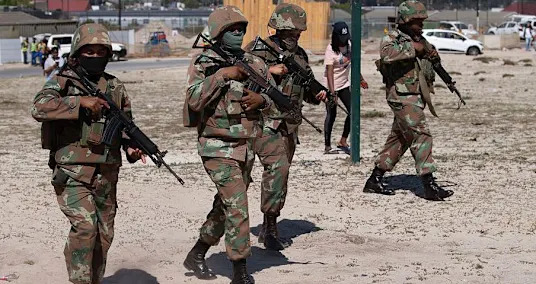
South Africa's army has officially been deployed to several parts of the country to help overwhelmed police clamp down on violent crimes, including illicit mining and gangs.
President Cyril Ramaphosa earlier this year announced the deployment of 2,200 soldiers to five of the country's nine provinces hardest hit by criminal activities.
Authorities say the deployment, set to run for a year, is aimed at restoring order to crime-ridden areas, but critics warn that using the military in civilian policing rarely delivers lasting results.
Illicit mining and gang violence are major problems in South Africa, which has one of the world's highest murder rates.
An initial group of soldiers was deployed to several parts of Gauteng province, which includes Johannesburg, in March.
The second, and main cohort, will help with operations in the Eastern Cape, Free State, North West and Western Cape provinces from 1 April for a year.
The BBC spoke to several residents in a Johannesburg suburb, Eldorado Park, a few weeks after soldiers arrived in the area. It is one of the three Johannesburg suburbs targeted in the initial military deployment due to the high levels of gang violence there.
Some of those interviewed expressed scepticism about the soldiers' presence in their neighbourhood.
Leola Davies, a 74-year-old pensioner, described Eldorado Park as a "hell-hole to live in".
"Sodom and Gomorra have nothing on this place. I stay indoors all day because I just don't want to be the next victim. Things are getting worse," she said.
Elviena le Roux, a mother of three, told the BBC she doesn't believe having the military in the area will help, saying it will only "make the violence worse".
Ronald Rabie, 56, said that while seeing the army patrolling the streets makes some difference, as it creates a safer environment for families, this peace is short-lived.
"Once they leave, things return to chaos – they need to be here permanently," the father of three said.

This is not the first time Ramaphosa has deployed troops to help bring down the country's high crime levels.
In 2023, over 3,000 soldiers were roped in to help tackle illicit mining across the country for six months.
In July 2021, the army was also deployed to help quell the deadly riots that had hit the country after the arrest of former South African President Jacob Zuma.
Security experts have repeatedly warned that the military is trained for combat - not for the kind of community-based policing needed to build trust.
And there is also history to contend with. The racist apartheid regime used the military to enforce their rule - a legacy that still shapes how some South Africans view soldiers on their streets today.
Criminologist Guy Lamb told the BBC he was not convinced the deployment would deliver lasting results, saying soldiers are "not designed to engage in policing" but rather to engage in combat and use maximum force.
"There's danger that they will escalate situations or respond very aggressively in... tense situations," he said.
He cited their conduct during the Covid-19 pandemic as an example. The army's deployment during that period, meant to help enforce the curfew and other restrictions, drew sharp criticism as reports came out of soldiers using excessive force, unlawfully detaining and harassing civilians.
Authorities have expressed optimism that the soldiers' presence will make a difference this time around but Lamb is not completely convinced.
He said that without "a dedicated plan... to try and address why crime is so violent in these sort of places", there was a strong likelihood it would flare up again once the soldiers leave.
"So we're likely to see this happening into the foreseeable future, because this plan of addressing what are the root causes of crime [in these] areas is not in place."
Additional reporting by Khanyisile Ngcobo
More about South Africa from the BBC:

Go to BBCAfrica.com for more news from the African continent.
Follow us on Twitter @BBCAfrica, on Facebook at BBC Africa or on Instagram at bbcafrica
BBC Africa podcasts
LATEST POSTS
- 1
 Instructions to Guarantee Kids Foster Solid Dental Propensities
 - 2'Fertiliser costs mean I'm better off not planting'
- 3CDC advisory panel delays vote on hepatitis B vaccines after unruly meeting
- 45 Family SUVs for 2024: Which One Accommodates Your Family's Needs\uff1f
- 5Scientists may be overestimating the amount of microplastics in the environment – and the culprit is lab gloves



- German gas price bill signed into law, but consumers not impressed
- Alleged maple syrup scam in Quebec uncovered by Canadian broadcaster
- Fundamental Monetary Guidance for Going into Business
- Jubilant FoodWorks to scrap Dunkin’ franchise arrangement in India
- 25 Most Beautiful Villages in France You Can Actually Visit
- First Phosphate advances battery-grade phosphate project as analysts highlight strategic Federal support
- Was This Driver Simply Having A great time Or Behaving Like An Ass?
- Rediscovering Imagination in Adulthood: Individual Creative Excursions
- Mummified cheetahs found in Saudi caves shed light on lost populations