By Lucila Sigal
BUENOS AIRES, April 1 (Reuters) - An Argentine-built microsatellite, the only one from Latin America selected for NASA's return to the moon, will test experimental navigation systems and measure radiation far beyond Earth's orbit when it flies on the Artemis II mission.
The shoebox-sized satellite, known as ATENEA, is one of four international payloads chosen by NASA from proposals submitted by nearly 50 countries to accompany Artemis II, the first crewed lunar mission in more than half a century, which was scheduled to lift off later on Wednesday. The others are from Germany, Saudi Arabia and South Korea.
Developed by the engineering faculty at the University of Buenos Aires, with support from Argentina's national space agency CONAE and other scientific institutions, ATENEA will travel roughly 72,000 kilometers (44,739 miles) from Earth, well beyond the planet's protective magnetic field.
Argentina's project director Fernando Filippetti said the mission offers a rare chance for Argentine scientists to study conditions in deep space, where radiation levels are far higher and more volatile than in low-Earth orbit.
"Even though Argentina is better known for football, our space agency CONAE has built satellites of extremely high complexity, of world-class standard," Filippetti said, speaking by phone from Cape Canaveral, Florida.
The satellite will focus on measuring radiation exposure and test whether faint signals from Earth's GPS satellites can be harnessed to navigate far from the planet.
"This represents a unique opportunity to test and measure parameters in deep space," Filippetti said.
ATENEA will attempt to capture data with the aim of laying the groundwork for a future space-based GPS capable of determining a spacecraft's position far from Earth.
Argentina's space sector had quietly developed technology of global standard, despite limited resources, Filippetti said.
Libertarian President Javier Milei's government has sharply cut public spending since taking office in late 2023, with funding reductions hitting many state institutions, including CONAE.
NASA's launch with four astronauts will begin a 10-day flight around the moon, marking the most ambitious U.S. space mission in decades and a major step toward returning humans to the lunar surface before China's first crewed landing.
(Reporting by Lucila Sigal; Writing by Cassandra Garrison; Editing by Bill Berkrot)
LATEST POSTS
- 1
 Well known SUVs With Low Energy Utilization In 2024 vote
 - 2Novo Nordisk justifies reasoning behind failed GLP-1 Alzheimer's trials
- 3'Spending more on gas than groceries:' Rising fuel prices drive more San Antonio families to the Food Bank amid Iran war
- 4Grass Care Administrations for a Wonderful, Sound Yard
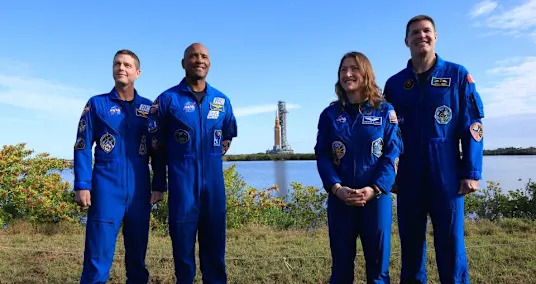
- 5NASA’s history-making moon mission aims to send the first woman and person of color to deep space


- Former 'Bachelorette' welcomes 1st baby via emergency c-section
- Unfathomable and Entertaining Legal disputes That Surprise everyone
- Sought-After Extravagance Ocean side Objections for a Lovely Escape
- Artemis will take Americans to the moon for the 1st time since 1972. Why has it been so hard to go back?
- What are parents to do as doctors clash with Trump administration over vaccines?
- From ‘Project Hail Mary’ to Artemis II, spaceflight captures audiences when it centers on people because human space travel is hazardous
- From Loner to Force to be reckoned with: Individual Accounts of Change
- Many European nations want Israel to cancel 19 new settlement plans
- Japanese H3 rocket fails during launch of navigation satellite (video)